
The Guardrails Are in the Data: Why AI Safety Starts Beneath the Model
Most of the AI safety debate is about the model. But once agents start acting on their own, the risk lives underneath it, in the data they read and the systems they can touch.
We are guarding the wrong door
Most of the AI safety debate is about the model: how it was trained, what it will refuse, how it scores on the latest benchmark. Those questions matter. But in the places where AI is now being put to work, they are no longer where the risk lives.
The risk lives underneath the model, in the data it reads and the systems it can touch. A well-aligned model that is fed the wrong data, or handed the keys to systems it should never reach, is not safe. It is just polite while it makes a mistake.
Agents act, and actions have consequences
For the first wave of generative AI, the worst case was a bad answer. A person read it, frowned, and moved on. Agentic AI removes that person from the loop by design. Agents query databases, trigger workflows, draft and send, flag and escalate. They do it at machine speed and at a scale no reviewer can match.
That changes the safety question. It is no longer only “what will the model say?” It is “what data can this agent see, what is it allowed to do, and can we prove afterwards what it did and why?” Those are not model questions. They are questions about data, identity, permissions and audit, and no amount of fine-tuning answers them.
Safety is a platform property
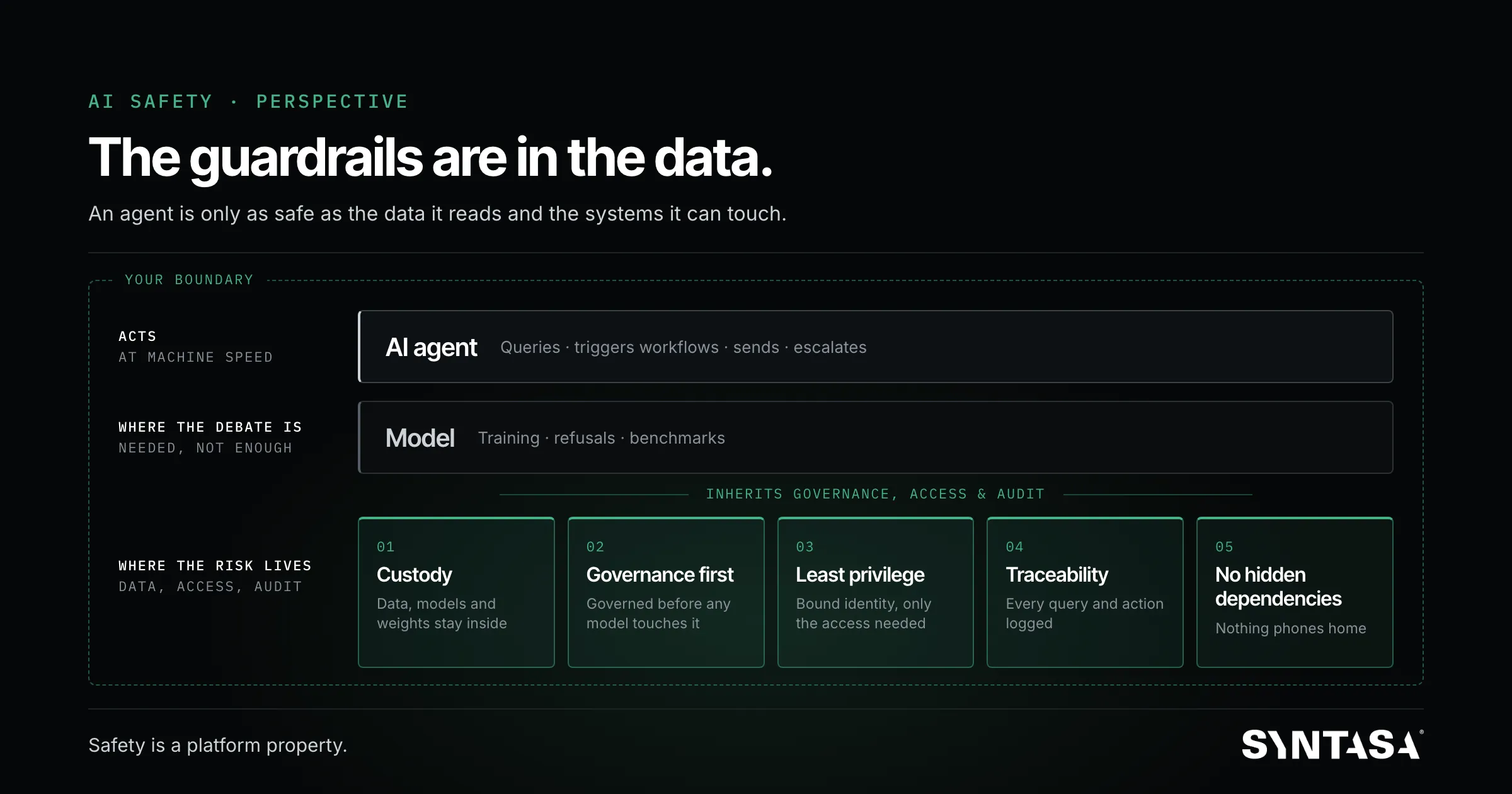
My argument is simple: in the agentic era, AI safety is mostly a data and platform problem. A safe agent is one that runs on a foundation with five properties.
- Custody. The organization keeps its data, its models and its model weights. Nothing leaves the boundary unless someone decided it should.
- Governance before intelligence. Data is prepared, labeled and governed before any model touches it, so agents reason over facts the organization actually trusts.
- Least privilege. Every agent acts under a bound identity with only the access its task requires, the same zero-trust discipline we already demand of people.
- Traceability and auditability. Every query, every movement of data and every action is logged, so an agent’s decision can be reconstructed and challenged.
- No hidden dependencies. No quiet calls to outside APIs, no telemetry phoning home. If you cannot see the dependency, you cannot govern it.
None of this is glamorous. All of it is what separates an AI system you can defend in front of an auditor, a regulator or a mission commander from one you merely hope will behave.
What this looks like in practice
At Syntasa, we built our data and agentic AI platform on the premise that you bring AI to the data, not the data to the AI. The platform runs inside the customer’s own boundary, on their BigQuery, S3, Snowflake or on-premises estate. Data is never copied into a Syntasa-owned store. The customer keeps the data, the models and the boundary; we hold none of it.
The same codebase covers ingestion and identity, governance and orchestration, model training and serving, agentic workflows and activation. That matters for safety. Agents are not bolted onto an ungoverned data lake after the fact. They inherit the governance, access controls and audit trail of the pipeline that feeds them.
The proof is in where it runs. The platform is FedRAMP High authorized, holds live federal ATOs and is certified on Google Distributed Cloud for air-gapped use. At one U.S. federal agency it went from air gap to operational use in six weeks, with no external dependencies and no data leaving the enclave. The same product, from the same code, serves commercial customers such as Lenovo, Sky and Currys at petabyte scale.
That last point is the one I would underline. Safety that only exists in the most classified environments is a niche. Safety that is the default architecture, from a retailer’s website to a classified network, is a standard.
Where I stand
I will be direct about my own view. I do not think AI safety will be won by slowing down, and I do not think it will be won by a handful of labs getting the model perfectly right. It will be won, or lost, in thousands of ordinary deployment decisions made by people who run data platforms.
I am wary of the pattern I see across the market, where the price of using AI is handing your data to someone else’s store. Lock-in is not just a commercial problem. When your data sits in a system you do not control, so does your ability to explain what your AI did with it. Sovereignty is a safety feature.
I also think our industry talks about safety in adjectives when it should talk in evidence. “Trusted,” “secure” and “responsible” are easy to print. Authorizations, audit logs, deployment timelines and measured outcomes are harder to fake. Buyers should demand the second kind, and vendors, including us, should expect to be held to it.
Finally, I believe safety and value are not a trade-off. The organizations that govern their data properly are the ones that can deploy agents fastest, because they are not relitigating trust on every project. The guardrails are what let you drive.
Four questions before the next agent ships
For any leader about to put agents into production, I would ask four questions before asking which model to use:
- Where does our data live while the agent works, and who else can see it?
- What exactly is this agent permitted to read and to do, and who approved that?
- If it gets something wrong, can we reconstruct every step it took?
- Does anything in this stack call out to a system we do not control?
If the answers are vague, the model is not your problem yet. Fix the foundation first. The next chapter of AI safety will not be written in research papers alone. It will be written in data platforms, one governed deployment at a time.
Want to test your own foundation against those four questions? Our team can walk through them with you, whether your agents run in a commercial cloud or on an air-gapped network.
← Back to Insights