
Know your community's health needs in weeks, not years.
Syntasa's AI-powered CHNA solution turns public health records, search trends, and census data into a data-driven Community Health Needs Assessment — without replacing the community engagement your assessment still requires.
A federally required assessment that is out of date before it is published.
Public health departments, nonprofit hospitals, and Federally Qualified Health Centers must complete a Community Health Needs Assessment every three years. The traditional process — focus groups, resident surveys, manual data pulls across siloed public and private sources — is largely manual and can take up to a year. Dearborn's own CHNA took 18 months of partnership work to produce.
By the time survey data is analyzed and the report is published, it can be nearly a year out of date. The health concerns a community is actually living with — a rise in overdoses, a spike in anxiety searches, a new cluster of respiratory illness — don't wait for the next assessment cycle to surface.
Four shifts in how an assessment gets built.
Cut the assessment cycle from up to a year down to weeks
Collects and cleans data from 70+ public and private sources — electronic health records, census data, Wayne State University's Project PHOENIX data warehouse — into consolidated pipelines ready for analysis with Vertex AI, replacing manual, siloed data pulls.
A human defines the report's structure; Gemini extracts insights from the relevant datasets and fills in the detail — turning a task that traditionally takes up to a year into one delivered in a matter of weeks.
Surface what the community is already telling you
Combines official survey data with real-time signal from Google Search and social media to surface what residents are asking about and posting — in the Dearborn pilot, rising searches for terms like "anxiety" and "stroke," and growing discussion of asthma and clinic wait times.
Analyzes public social media discussion to surface emerging topics — in the Dearborn pilot, Safety was the most-discussed community topic, a concern not among the community's four final CHNA priorities but a real signal worth tracking.
AI that augments your community process, not replaces it
The person managing the CHNA defines the report's structure; Gemini fills in the analysis. Public health experts review AI-drafted findings and summaries for accuracy before anything is finalized.
Because the underlying data pipeline runs continuously, the assessment can be kept current with fresh data rather than published once and left to age for three years.
Turn findings into targeted action
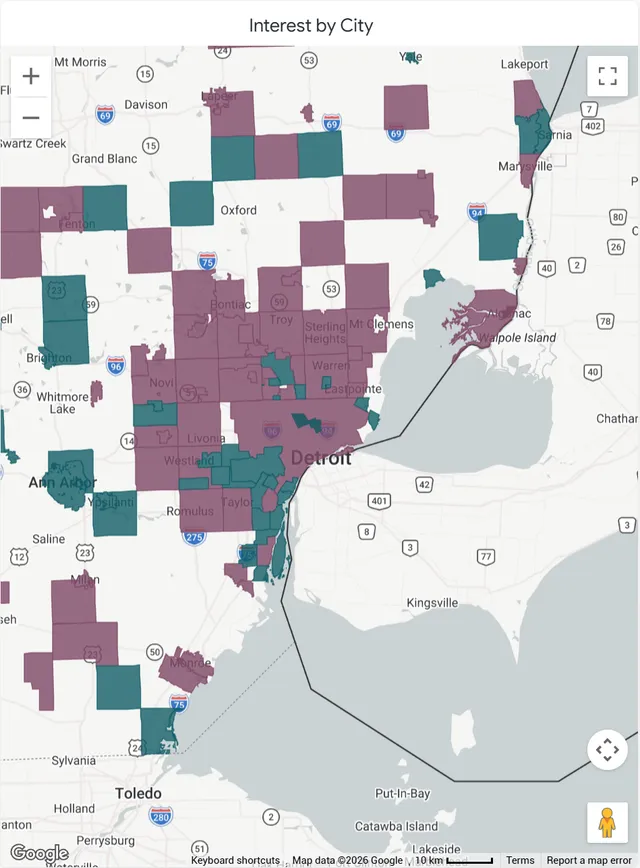
Ranks neighborhoods against each other across dozens of health and socioeconomic metrics — poverty, unemployment, insurance coverage, chronic disease rates — so interventions can be targeted rather than citywide.
Findings presented through interactive geographic and topic visualizations for exploration by neighborhood and search interest, instead of a static PDF report.
The same four layers, applied to public health.
CHNA 2.0 runs on Syntasa's Data + Agentic AI platform, deployed inside your own Google Cloud environment.
Ingests and cleans public and private health data — EHR data, census, Wayne State's PHOENIX warehouse, search and social trends — into one governed pipeline built on Google Kubernetes Engine, Cloud SQL, and Cloud Storage.
Vertex AI and Gemini power trend analysis, topic modeling, categorization, and generative drafting of report narrative and summaries; BigQuery handles the sentiment-analysis workload at scale.
Orchestrates the multi-step CHNA workflow: pulling from the right datasets per the human-defined report structure, drafting each section, and routing output to public health experts for review before anything is finalized.
Turns findings into interactive dashboards and neighborhood-level targeting so public health teams can act on results, not just read them.
Dearborn, Michigan — the first city to deploy CHNA 2.0.
Delivered in partnership with Wayne State University and Google Public Sector, to great success.
Read the Google Cloud story"Google's AI gives this solution its horsepower — Vertex AI and Gemini can make sense of dozens of data sources at once. What turns that horsepower into a CHNA a health department can trust is Syntasa's Data + Agentic AI platform, and the know-how to stand it up for public health agencies. That's how you get from a manual process that used to take a year to an automated one that takes weeks."

Your data and models stay in your boundary.
The solution deploys into your agency's own private Google Cloud account. No data is shared with Syntasa or Google — everything stays inside your environment.
No certifications are listed for this solution: the Dearborn project did not involve PHI.
Visit the Trust CenterBuilt with the ecosystem
Developed Project PHOENIX — Population Health OutcomEs aNd iNformation eXchange — the data warehouse of 70+ anonymized sources this solution builds on. Led by Dr. Phillip Levy, M.D., M.P.H.
Delivery partner. Vertex AI, Gemini, GKE, Cloud SQL, Cloud Storage, and BigQuery form the technical foundation.
Interactive dashboard layer for presenting findings by neighborhood and topic.
Resources
Google Cloud Next 25 session on sentinel surveillance and Project PHOENIX.
How Wayne State University, Google Public Sector, and Syntasa built CHNA 2.0.
The city's results release — the community process behind the assessment, not the AI solution itself.
Questions agencies ask
No — the AI analysis is designed to run alongside your existing community engagement, not instead of it. In Dearborn, the AI-driven approach independently confirmed several community-voted priorities using public data, but priorities that only surface through direct resident input — like health literacy — still need that input.
Public health records, census data, Google Search trends, and — where available — social media discussion, consolidated into a single pipeline for analysis with Vertex AI.
A traditional CHNA can take up to a year to complete manually. Syntasa's CHNA 2.0 solution, built with Wayne State University and Google Public Sector, delivers a complete assessment in a matter of weeks.
Public health experts review AI-drafted summaries and reports for accuracy before anything is published — the AI drafts, people verify.
None of your data is shared with either Syntasa or Google — it all stays within your agency's own private Google Cloud account.
Request a briefing on your next assessment cycle.
Tell us when your CHNA is due and what data you already hold. We'll walk through what CHNA 2.0 would look like in your own cloud environment, alongside the community process you already run.