
McLean, VA – March 30 – Syntasa today took a further leap into adopting Agentic AI in its platform as it released its 9.1 version. This is a significant step forward in how enterprise marketing teams manage campaigns, activate customer intelligence, and work with AI.
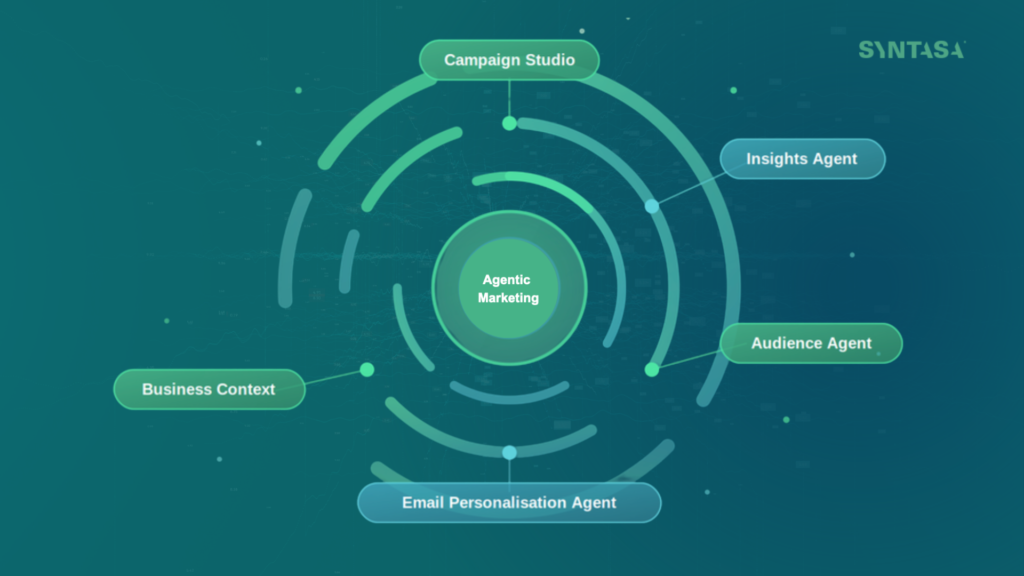
The release introduces two foundational capabilities that redefine how marketers operate: a Campaign Studio that consolidates Web, Email, and Paid Media campaign management into a single interface, and three Conversational AI Agents guided by Business Context enabling teams to interact with AI through natural conversation, grounded in high-level business context rather than engineered prompts.
The Problem This Solves
Enterprise marketing teams today face a two-sided execution problem.
On one side: campaign management is fragmented. Web campaigns live in one tool. Email in another. Paid media in a third. There is no unified view of campaign health, no single place to act, and no shared context across channels. Teams spend more time managing their tools than managing their strategy.
On the other side: AI in marketing still demands too much from the user. Most tools require precise prompt engineering to produce useful outputs putting the burden on marketers to learn a new discipline just to access intelligence that should already be available to them.
The 9.1 release is built to solve both.
Campaign Studio
At the core of the new release is a campaign management interface that brings every campaign across Web, Email, and Paid Media into a single, actionable workspace. Marketers can now view all campaigns by status, channel, and performance in one place. The three-step campaign workflow: Define, Personalize & Deliver, Activate, standardizes execution across channel types without sacrificing channel-specific configuration. Campaign logic can be saved as reusable rules, applied across multiple campaigns, and managed from a single dashboard without switching tools or losing cross-channel context.
The Campaign Health Dashboard gives teams a live view of performance across all three channels simultaneously making it possible, for the first time, to make channel decisions with full-picture context rather than siloed metrics.
Context Engineering: A New Way to Work with AI
The 9.1 release introduces three Conversational Marketing AI Agents, each built on Context Engineering – a layered design principle that shifts the responsibility of AI interaction from the user to the platform.
At its foundation, Context Engineering operates through a structured framework of context layers. Technical system instructions and industry-level business instructions are configured behind the scenes, ensuring the agents understand how to operate, communicate, and apply domain-specific logic without exposing complexity to end users. Client-level technical rules further tailor the agent to each organization’s data schema and standards.
On top of this foundation sits the Business Context layer – high-level, intent-driven settings that business users configure once to define the current mission: who the customer is, what the campaign goal is, what segment or outcome they’re focused on. This is the “set it and forget it” layer that shapes every conversation that follows.
With that context in place, teams don’t need to craft precise prompts to get useful outputs. Instead, the agents engage in natural, back-and-forth conversation, taking business instructions in real time – clarifying questions, refining parameters, and acting on intent rather than literal commands. The outcome is AI that works the way a knowledgeable colleague would: already briefed on the mission, ready to take direction and deliver results.
Customer Insights Agent: Transforms plain-English business questions into precise data queries, delivering visualized intelligence directly within the platform. Teams no longer need to raise a request to the data team to understand what is happening in their customer base. They ask. The agent answers.
Customer Audience Agent: Converts high-level audience descriptions into precise, actionable segment definitions. A marketer can describe a target in their own language – “high-value customers showing early signs of churn in the last 60 days” and the agent builds the segment logic within their existing data environment. No rule-builder expertise required.
Email Personalization Agent: Generates personalized subject lines and email body copy at scale, informed by customer context, campaign goals, and the business context set by the team. This is not template substitution. It is personalization grounded in the full picture of who the customer is and what the campaign is trying to achieve.
Executive Perspective
"The gap between having customer data and being able to act on it has never been a data problem. It has been an execution problem. The 9.1 release closes that gap by giving marketing teams one place to run their campaigns and marketing AI that meets them where they are, not where the technology requires them to be."
Jay Marwaha, CEO, Syntasa
"Context Engineering changes the relationship between marketers and AI tools. When you stop asking people to engineer prompts and start asking them to describe their business intent, you get faster results and broader adoption. That is what we built for."
Charmee Patel, VP - Data & AI, Syntasa
Snapshot of What Comes with the 9.1 Release
The 9.1 release includes:
- Home Dashboard: A unified workspace featuring campaign health performance cards, an activity feed, and AI-recommended next steps surfaced through the Smart Workspace.
- Campaign Studio: Unified management of Web, Email, and Paid Media campaigns with a standardized 3-step workflow, campaign rules library, and cross-channel performance dashboards.
- Customer Insight Agent: Conversational natural language to data query capability, grounded in business context.
- Customer Audience Agent: Plain-English to segment definition capability, operating within the existing data environment.
- Email Personalization Agent: Context-informed personalized copy generation at scale.
- Profile Attributes: Centralized visibility into the global attribute layer powering customer profiles.
- Identity Resolution: Golden Record matching (deterministic and probabilistic) operating within the enterprise’s existing cloud infrastructure.
Availability
The 9.1 release is now available for existing Syntasa customers and qualified enterprise prospects. To request a demo or learn more, click the button below.
About Syntasa
Syntasa is a warehouse-native, modular platform powered by agentic AI — unifying customer data to deliver smarter personalization, deeper insights, and real-time activation at scale.