
Built to rank or built to be chosen: why your SEO playbook doesn't transfer to AI agents
AI assistants no longer hand shoppers a ranked list — they choose three or four brands and stop. Winning a place in that shortlist depends on product data an agent can trust, not the SEO tactics built for human readers.
Ask an AI assistant for a product recommendation and you get three or four brands.
Not thirty. Not a ranked list you can scroll. Three or four, selected on the shopper’s behalf and presented as an answer rather than a set of options.
That is the part worth sitting with, because it changes the shape of the problem. Around 35% of shoppers now use AI tools at the discovery stage, against 13.6% on traditional search. When they do, the assistant surfaces a handful of brands and stops. The ones outside that handful are not ranked lower. They are absent, and there is no page two to climb to.
So the question stops being how do we rank higher and becomes something less familiar: can an agent read our data well enough to put us in the answer at all?
Most brands are still answering the first question. Their catalog was built for it.
What SEO was actually optimizing for
It is worth being precise about what the old playbook assumed, because the assumptions are what broke, not the tactics.
Search engine optimization rested on four premises. There is a page. A human reads it. That human sees a ranked list. And they click.
Everything downstream followed. Keyword-matched titles and descriptions, because a person scans for recognizable words. Backlinks, because authority had to be inferred from who pointed at you. Meta descriptions, because you were writing a pitch for a results page. Page speed, because a human abandons a slow load.
None of it was wrong. It was a rational response to how discovery worked, and it worked for two decades.
But every one of those premises assumed a reader who browses, compares and decides. An agent does none of those things.
What an agent needs instead
An agent does not browse. It queries.
It does not form an impression of your brand from your homepage. It asks structured questions and takes structured answers. Where an answer is missing, slow or internally inconsistent, it moves on to a brand that answered cleanly. There is no equivalent of a shopper giving you the benefit of the doubt because the photography looked good.
Three things it needs, none of which are content problems.
- Attributes it can parse. Not “breathable summer fabric” buried in a description, but material, weight, fit and season as discrete, queryable fields. A person infers. An agent needs it declared.
- Availability it can trust. Real-time, at variant level. An agent that recommends an item you sold out of yesterday has damaged the customer’s trust and yours in the same sentence. And it will learn not to do that again.
- Eligibility it can check. Whether this offer applies to this customer, in this market, at this moment. The April 2026 release of the Universal Commerce Protocol added precisely this: eligibility claims and a verification contract, alongside catalog search and lookup capabilities for product discovery. Read the specification and the direction is unambiguous. Agents are being given the ability to ask exact questions, which means the answers now have to exist.
And critically, an agent cannot be persuaded. It has no aspiration to be seen carrying your bag. Copy that would move a person moves nothing here. What moves an agent is whether the data supports the recommendation.
SEO vs AI search: four contrasts that matter
The shift is easiest to see side by side.
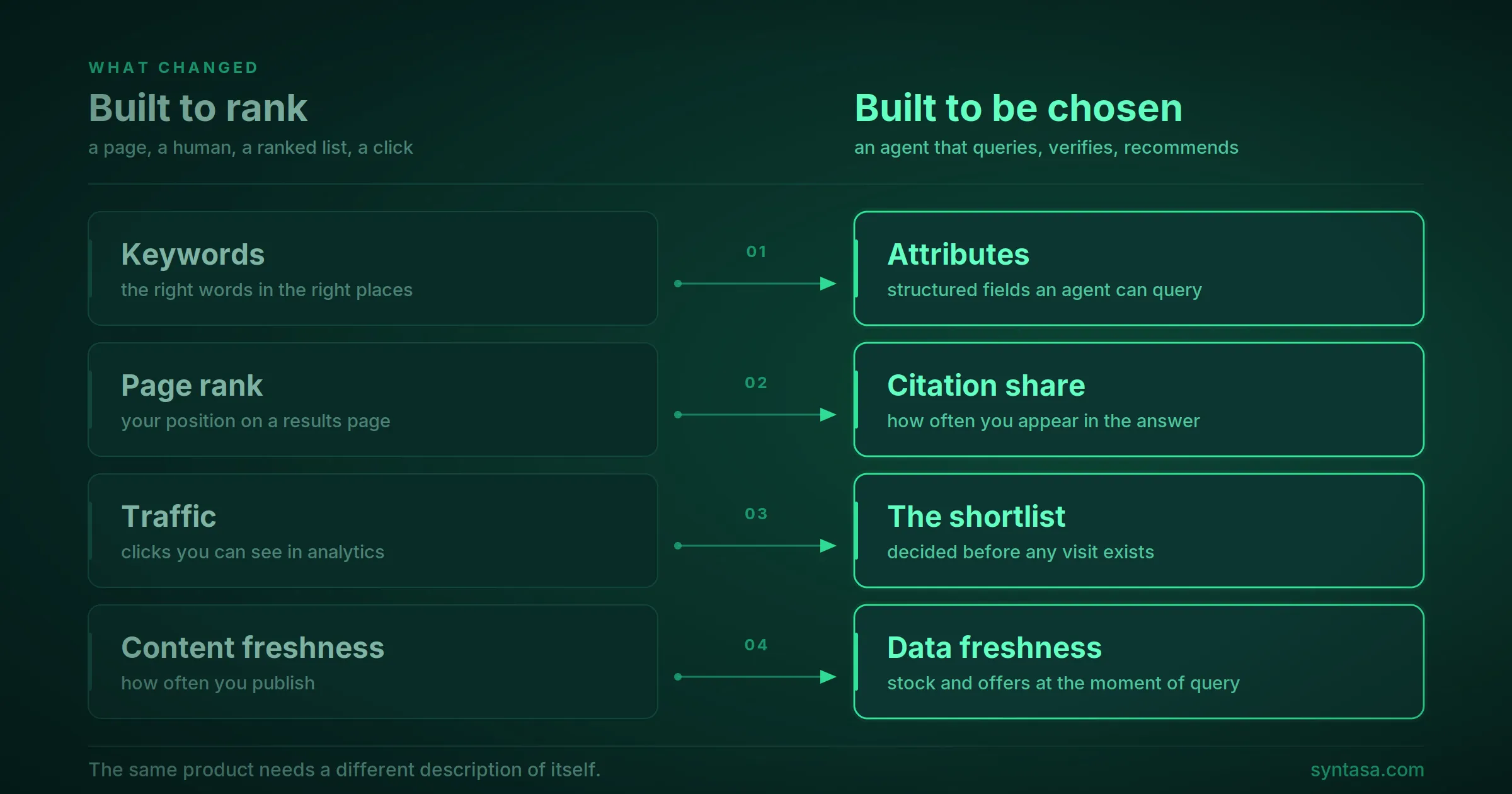
Keywords become attributes. SEO rewarded the right words in the right places. Agent retrieval rewards structured, queryable fields. The same product needs a different description of itself.
Page rank becomes citation share. Position on a results page was the old scoreboard. The new one is how often you appear in the answer, across assistants, for the queries that matter to your category. It is a harder number to see, which is exactly why most brands are not measuring it yet.
Traffic becomes being shortlisted. Traffic was the goal because traffic converted. Now the decisive moment happens before any traffic exists, in the shortlist the agent assembles. You can lose without ever seeing a visit, and without anything in your analytics telling you why.
Content freshness becomes data freshness. Publishing cadence used to be the freshness signal. Now it is whether your inventory, pricing and offers are current at the moment of the query. A blog updated weekly and a stock feed updated overnight are no longer the same kind of stale.
Why this is a data project, not a content project
Here is the uncomfortable part, and the reason this transition stalls inside most organizations.
None of those four contrasts can be closed by a content team.
Attribute completeness lives in the product information management system. Real-time availability lives in inventory. Eligibility lives in pricing and promotions logic. Reviews and sentiment, broken out by attribute rather than averaged into a star rating, live in a review platform that was never designed to be queried that way.
All of it exists. Almost none of it exists in one place, in a form anything can query within the time an agent is willing to wait.
Scott Brinker has a useful name for this gap. He describes three kinds of context: the customer’s context, the company’s context, and systems context, meaning the subset of the first two that is actually visible and actionable in your systems. Where all three align, he calls it Golden Context. His observation is that for most businesses, only a fraction of the first two ever reaches the third.
That is the work. It is not a rebrand or a new tone of voice. It is the unglamorous business of getting data the company already owns into a state where software can use it. Which is why it tends to sit unowned, somewhere between the marketing team that feels the symptom and the data team that holds the fix.
One more thing worth naming, because it determines where the effort should go. In-agent checkout has not become the norm many predicted. OpenAI withdrew Instant Checkout in March 2026, roughly five months after launching it, after Walmart found that purchases completed inside ChatGPT converted at about a third the rate of click-throughs to Walmart.com. Shopify moved in the same direction. Google’s agentic checkout remains US-only.
The pattern that has actually formed is this: discover in the assistant, buy on the brand’s own site.
Which is better news than it sounds, because it means both decisive moments belong to you. Product data good enough for an agent to find you and describe you accurately. And an agent on your own site capable enough to convert once the shopper arrives. Neither is something a platform will hand over.
The question worth sitting with
If an AI agent read your product catalog this afternoon, what would it be unable to tell a customer?
Most catalogs can supply a title, a description, a price and a category. Fewer can say whether an item is in stock in the right size, right now. Or which products are genuinely substitutable. Or what reviewers actually say about fit, as opposed to an average star rating.
That gap is the difference between being recommended and being skipped. And unlike a ranking problem, you cannot see it from the outside. Nothing tells you which shortlists you did not make.
Being chosen starts with knowing what an agent can actually see.
The Agentic Commerce Readiness Check evaluates five of the capabilities that determine whether AI shopping agents can find, understand and act on your product data. In about five minutes, you’ll see where your commerce stack is ready, where context is missing and what to address first.
← Back to Insights