
For decades, organizations have invested enormously in making more data available. We moved from operational databases to data warehouses, from warehouses to cloud data platforms, and increasingly to sophisticated analytics infrastructure.
But one thing hasn’t fundamentally changed: getting an answer from data still requires knowing quite a lot about the data.
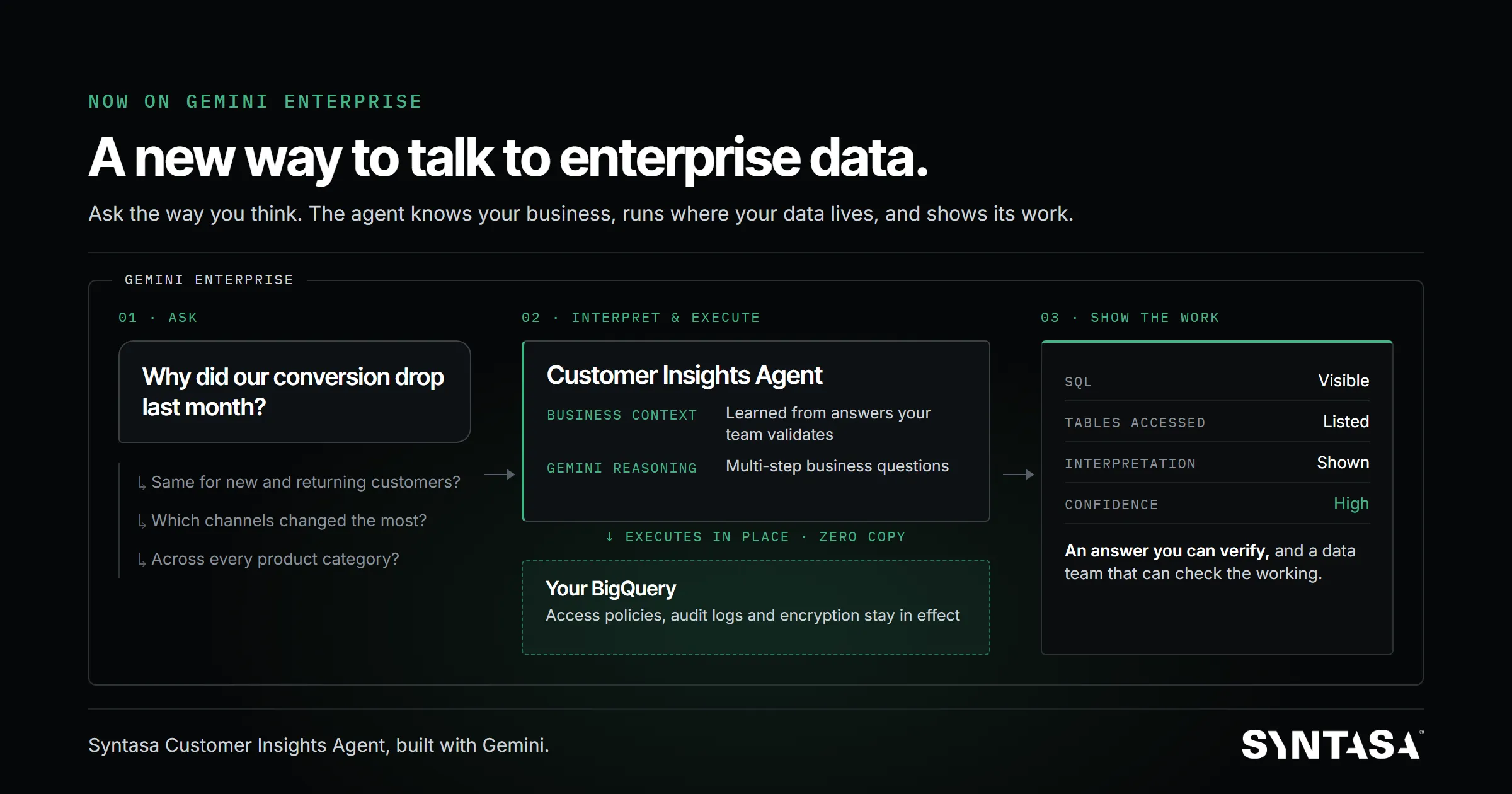
A business user might ask something perfectly reasonable: Why did our conversion drop last month? Who are our highest-value customers? Which marketing channels are driving engagement?
Answering these questions often requires knowing which datasets contain the relevant information, how the organization defines key terms, what filters should be applied, and sometimes whether the observed pattern is even statistically meaningful. Traditionally, someone who deeply understands both the data and the business sits between the question and the answer. Often, that person is busy, and the cycle is slow.
Generative AI gives us an opportunity to change that.
From translation to conversation
Natural language to SQL has existed in various forms for years, and LLMs have made it dramatically better. But generating SQL isn’t the same as understanding a business question.
Consider the simple question: Who are our best customers?
There is no universally correct query for that. Does “best” mean highest lifetime value? Most frequent purchases? Highest predicted future value? Most engaged? Should returns be factored in? What about customers who haven’t purchased recently?
An experienced analyst doesn’t immediately write SQL. They interpret the question using what they know about the business, its priorities, and its data. They think about context.
That’s what we set out to build into the Customer Insights Agent. The goal isn’t simply to translate English into SQL. It’s to enable agents that understand enough about an organization’s data and business definitions that people can ask questions the way they naturally think about them—and keep going.
Why did conversion drop? Was it the same for new and returning customers? Which channels changed the most? Is that happening across every product category?
Analysis is rarely one question followed by one answer. It’s iterative. One observation creates the next question. A useful data agent needs to work the same way.
How agents learn your business
LLMs are remarkably good at reasoning, but they arrive with no knowledge of what your organization’s data actually means.
Every enterprise has its own vocabulary. A “customer” in one system may mean something entirely different in another. Revenue can be defined multiple ways. Marketing channels are classified differently across teams. A metric that sounds obvious might depend on years of institutional knowledge scattered across data models, dashboards, SQL, and people’s heads.
Rather than asking organizations to hand-craft comprehensive ontologies upfront, we built a learning harness into the Customer Insights Agent. Every time you validate an answer, that becomes a reference point. When you flag something as incorrect, we capture that feedback. Over time, the agent builds understanding from real usage patterns and validated examples from your business.
This is how the agent self-evolves. It’s not magic. It’s structured learning—your team continuously teaches the agent what right looks like in your business, and the harness ensures that learning compounds. The agent becomes smarter the more you use it.
Trust means showing the work
There’s a fundamental difference between asking an AI a general knowledge question and asking it something that might influence a business decision.
The answer has to be verifiable.
Business users shouldn’t need to understand your data model to ask a question. But your analysts and data teams absolutely need to see what happened behind the scenes. What data was queried? How was the question interpreted? What exactly was executed? How was the answer derived?
This is why the Customer Insights Agent shows you everything. The SQL. The tables accessed. The logic. The confidence level. Not because it’s a nice feature, but because trust in AI-driven insights requires transparency. Your data team can validate it. Your business users can act with confidence. Everyone can see the working.
Keep data where it belongs
Organizations have spent years building governance around their cloud data environments—permissions, encryption, auditing, data quality policies, access controls. That infrastructure works. It’s maintained. It’s audited.
An AI agent shouldn’t require you to copy that data to an application layer and rebuild all of those protections again. That’s maintaining two systems. They drift. One gets updated, the other doesn’t.
The Customer Insights Agent is designed differently. It pushes execution down to your underlying data platform. Data stays where your organization already manages it. Your BigQuery access policies, your audit logs, your encryption—they all remain in effect. The agent inherits your governance automatically. There’s no second layer to maintain.
This becomes even more critical as agents move from answering questions to taking action. Today you ask: Why did conversion fall? Tomorrow you might ask: Find the customers most affected and create an audience for analysis. The closer agents get to action, the more governance and transparency matter.
Built with Google
We couldn’t have built this without Google’s partnership. The Gemini models—particularly the reasoning capabilities in Gemini Pro—made it possible to create an agent that handles complex multi-step business reasoning reliably. Google’s team was instrumental in helping us bridge the zero-copy gap and push the boundaries of agent-to-agent orchestration, making it possible for the Customer Insights Agent to work seamlessly as part of a broader multi-agent system.
Having the Customer Insights Agent available natively on Gemini Enterprise means your team accesses it in the same place they’re already using Gemini for other tasks. It’s not a separate tool. It’s an extension of your AI assistant, purpose-built for your data warehouse.
Available now on Gemini Enterprise
Today, we’re announcing that the Customer Insights Agent is available on Gemini Enterprise through Google Cloud Marketplace.
For users, the interaction is intentionally simple: ask a question. Behind that question is something much richer—your business context, your enterprise data, your existing governance, and the analytical rigor required to turn a question into an answer you can actually use.
You can start with a free trial to see how it works with your data. Connect your BigQuery tables, set up your business context, and let your teams experience what it means to have a conversation with your data instead of waiting for a data engineer.
The opportunity ahead
For years, the focus has been on giving more people access to data.
Perhaps the more interesting challenge now is giving more people the ability to question it. To explore. To iterate. To uncover insights that matter to their business without getting stuck waiting for technical resources.
The Customer Insights Agent, built with Google’s Gemini and available on Gemini Enterprise, is our answer to that challenge. It’s designed for organizations that want to adopt AI for customer intelligence but need to do it with trust—with transparency, security, and governance built in, not bolted on afterward.
We’re excited to see what your teams discover.
Ready to have a conversation with your own data? Request a free trial of the Customer Insights Agent on Gemini Enterprise, connect your BigQuery tables, and see what your teams ask first.