
How Google's UCP and warehouse-native context power the future of agentic shopping
The Universal Commerce Protocol has made agent readiness legible for the first time. What it hasn't done is make your data ready — that work still sits in your warehouse.
Commerce has changed where it starts before: store to browser, browser to phone, phone to feed. It is happening again, and this time the shopper is not the one doing the looking. An AI agent is. It reads a question, queries whatever product data it can reach, and returns three or four options. Adobe Analytics put traffic to US retail sites from generative AI tools up 693.4% year over year across the 2025 holiday season. On Shopify’s fourth quarter earnings call in February, president Harley Finkelstein said orders reaching Shopify stores from AI search were up fifteenfold since January 2025, off what he was careful to call a small base. McKinsey puts the destination at $3 trillion to $5 trillion of global consumer commerce mediated by AI agents by 2030.
What makes this shift different from the last three is that it has a protocol, which means for the first time you can know precisely whether your business is ready. It also means the hard part is now visible. A protocol defines the shape of the answer. It does not produce the answer. That work sits in your data, and it is the difference between being one of the three or four brands an agent names and being one it never reaches.
What is UCP, and why does it matter now?
The Universal Commerce Protocol is an open standard for how commerce data and transactions move between merchants and AI agents. Google and Shopify announced it at NRF on 11 January 2026, and it does for agentic shopping roughly what a shared file format does for documents: it removes the need to build a bespoke integration for every surface a customer might shop on.
Two things about UCP are worth knowing before you plan around it.
It’s moving fast, and its versions are dated, not numbered. The releases so far are v2026-01-11, v2026-01-23, v2026-04-08 and v2026-08-25. There is no “v0.8,” and secondary trackers frequently invent one. The April 2026 release is the one that mattered most for functionality: it added a cart capability for basket building, catalog search and lookup, request and response signing, eligibility claims and a verification contract, a formalized totals contract, discount handling, order operations with authentication, and OAuth 2.0 identity linking. The August 2026 release mattered more for structure: it reorganized the protocol so it could expand into new verticals beyond retail, strengthened payment security, and let each capability be versioned on its own instead of all at once.
The field has kept consolidating around it, month after month, since the April Tech Council expansion. On 24 April 2026, Amazon, Meta, Microsoft, Salesforce and Stripe joined the UCP Tech Council, alongside founding participants Google and Shopify. On 16 July 2026, a Food Technical Council formed with Block, DoorDash, Google, Toast and Uber Eats. On 11 August 2026, a Lodging Technical Council formed with Amadeus, Booking.com, Expedia, Google, Hilton, Marriott and Trip.com. On 2 September 2026, a Payments Technical Council formed with Adyen, Ant International, Coinbase, Global Payments, Google, PayPal, Shopify and Stripe. Google is a member of every one of these councils. When the companies that own the demand surfaces, the storefronts, the booking engines and the payment rails all standardize on one specification, the specification stops being a bet and starts being a requirement.
Read the release list again and notice what it is actually asking for. Catalog search and lookup assumes a catalog an agent can query, not a feed it can crawl. Eligibility claims assume you can state, per shopper and per item, whether an offer applies. A totals contract assumes your pricing, tax, shipping and discount logic can be resolved on demand and defended. None of that is a document you publish. All of it is data you have to be able to produce, live, on request.
Why is the protocol the easy part?
Because a protocol defines the shape of the answer. It does not produce the answer.
This is the part most readiness conversations skip. A brand adopts UCP, connects a surface, and discovers that the agent is now asking questions its own systems have never had to answer in one place. Catalog lives in a PIM. Reviews live with a third-party provider. Inventory lives in an ERP. Pricing and promotions live in a merchandising tool, and the rules that govern them often live in someone’s head. Customer data is split across a warehouse, an ESP and an analytics stack.
For twenty years that fragmentation was survivable, because the interface was a page. A page can be assembled slowly, from many sources, and a shopper will wait a second for it. An agent will not. It asks a specific question, takes whatever comes back within its budget, and cites the brands whose answers were usable.
Your catalog gets you found on Google. It will not get you chosen by agents. Catalog data optimized for keyword match is built to rank. Agent-ready data is built to be chosen, which is a different specification entirely: structured, queryable, current, and complete enough that a machine can defend a recommendation.
The stakes are simple arithmetic. AI answers surface three to four brands per query. Queries in AI mode run two to three times longer than traditional search queries, which means they carry more constraints, which means more brands get filtered out on details their data could not supply. There is no page two to be on.
What does a context layer actually do?
Scott Brinker’s framing in the 2026 State of Martech is the clearest available. He distinguishes the customer’s context, the company’s context, and systems context, meaning the subset of the first two that is actually visible and actionable inside your systems. For most businesses only a fraction of what they know ever reaches systems context. Closing that gap, he argues, is the work.
That gap is exactly what Syntasa closes, and it does two jobs to close it.
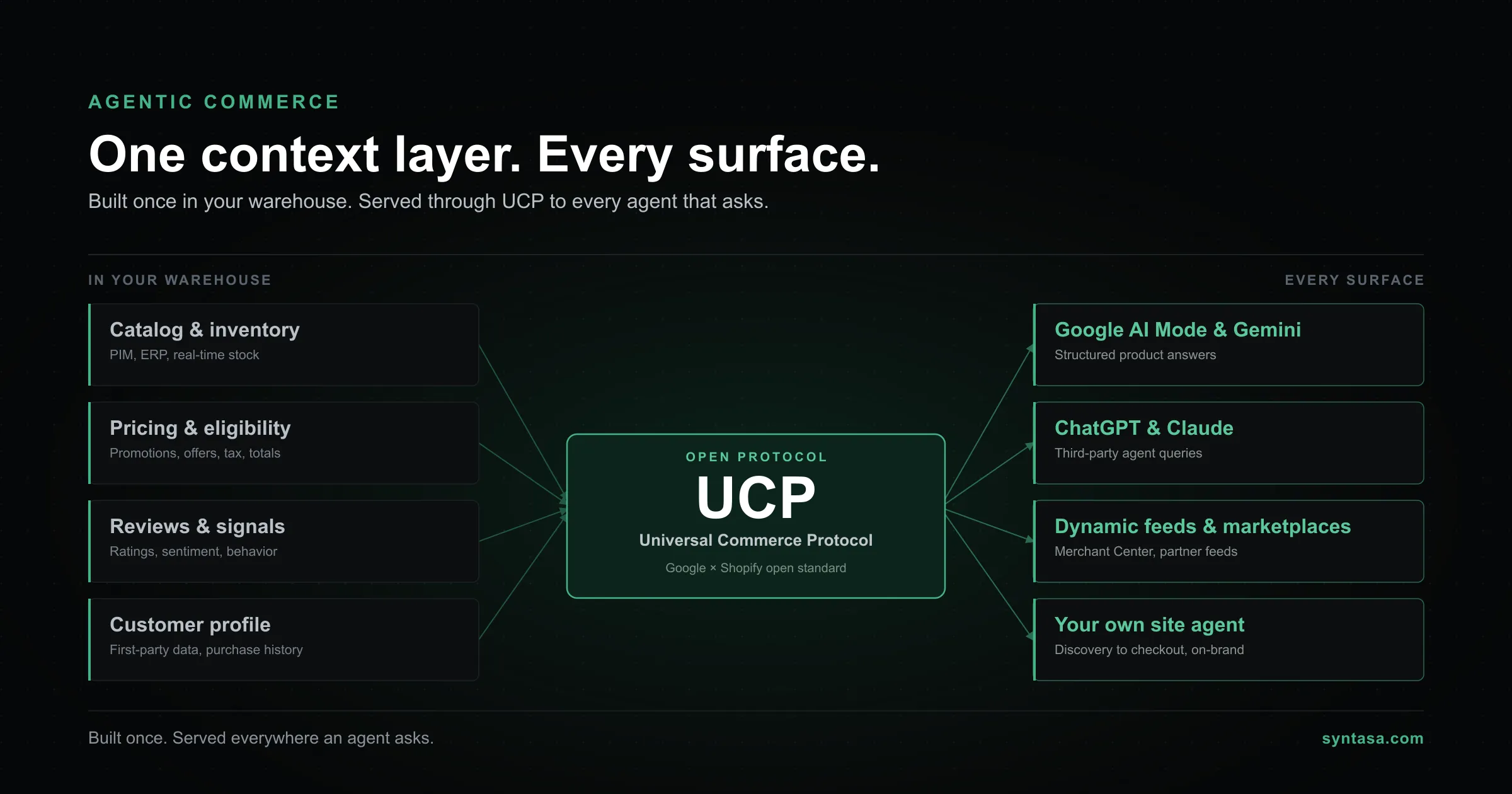
On the product side, it merges and restructures catalog, reviews, inventory, pricing and offers into structured output that any surface can consume: an AI agent, a UCP endpoint, a Merchant Center feed, on-site search, a partner marketplace, the brand’s own storefront. That is what makes a brand appear, accurately, when someone asks an assistant for a recommendation.
On the customer side, it unifies first-party customer data so the brand’s own shopping agent knows who it’s talking to. Aaiz Khan, Syntasa’s Product Marketer, describes the requirement through a salesperson: the great one knows the products cold and remembers the customer. An agent needs both, and most brands’ data can give it neither.
All of this runs inside the brand’s existing data warehouse, on AWS, Azure, Snowflake or Google Cloud. That distinction matters more than it sounds. Warehouse-native is not warehouse-locked. There is no new system to buy, no copy of the customer file leaving the perimeter, and no dependency on having picked the right platform vendor two years ago.
One layer, every surface
The reason to build context once, in the warehouse, is that the surfaces will keep multiplying.
Today it is Google’s AI Mode and Gemini, ChatGPT, Claude, dynamic feeds and the brand’s own on-site agent. UCP is what makes those surfaces addressable through one specification instead of six integrations. But UCP still has to be fed, and the brand that has built its product and customer context once can serve every one of those surfaces from the same source. The brand that builds per channel is committing to rebuilding for whichever surface arrives next.
Discover in AI, buy on site
One correction to the prevailing story, because it changes where the investment should go.
In-agent checkout has not become the default anyone expected. OpenAI withdrew Instant Checkout in March 2026, about five months after launch, after Walmart found that in-ChatGPT purchases converted at roughly a third the rate of shoppers who clicked through to Walmart.com. Shopify moved to Agentic Storefronts. Google’s agentic checkout remains US-only, even though AI Mode itself is live in the UK and more than forty European markets.
The pattern that is working is discovery in AI and conversion on the brand’s own site, with a capable agent waiting there. Macy’s is the public example: their Gemini-powered “Ask Macy’s” assistant, on their own site, produced roughly 375% higher spending and revenue per visit 4.75 times higher among customers who used it during beta.
That is the same context layer doing both jobs. Product context gets you cited by the agent. Customer context makes your own agent worth arriving at.
What this means for your business
UCP has made agent readiness legible. The specification is public, the release notes are dated, and the questions an agent will ask your systems are now written down.
What it has not done is make the data ready. That work sits where it always did, in your warehouse, and it is the difference between being one of the three or four brands an agent names and being one of the ones it never reaches.
Syntasa’s Agentic Commerce Readiness Check is a short diagnostic of where your product and customer data stand against what agents are already asking for.
← Back to Insights